Angels hard as they come (6/27/03)
____________
Hulk. [Ang Lee, 2003.]
Variations on a theme of Lee and Kirby: somewhat-too-dedicated scientific Boy Wonder Eric Bana and his coworker and estranged girlfriend Jennifer Connelly [now typecast, I’m afraid, as the significant other of the mentally disturbed Great Man] are, notwithstanding their problems with emotional distance, forging merrily ahead into the scientific unknown at Berkeley, trying to advance the application of some sort of gamma-ray-energized nanotechnological goo [green not gray, as the frequent representations of madly-multiplying molecular chaos on their computer screens remind us][and as the color scheme requires — though, nota bene, whatever the traditional connotation of gamma radiation for longtime Marvel readers, it isn’t green at all, of course, but rather ultraultraultraultraviolet] to the repair of biological organisms.
Thus far, alas, they’ve mainly succeeded in finding new ways of making frogs explode; a cause of much anxiety since, in a rare cinematic display of the realities of scientific funding, they have been backed into a position in which they must Demo or Die; or, worse, succumb to the blandishments of the military — represented by romantic rival Josh Lucas, who works for Jennifer’s father, four-star general Sam Elliott, who in the somewhat-distant past fired Bana’s longlost father, Mad Scientist Nick Nolte, who performed a variety of Forbidden Experiments on, among others, Bana himself and then disappeared into prison for thirty years, until reappearing, incognito, accompanied by an uncanny trio of weird mutant dogs who serve as his familiars, on the eve of these proceedings, as the deranged night janitor of the very building in which all this is taking place. [I think that was everything.]
Explaining all this, one need hardly say, requires the deployment of an enormously complicated apparatus of flashbacks, Big Closeups [Ang has a thing for eyeballs], Significant Glances, abrupt dissolves into near-recoveries of repressed memories, splitscreen explorations of multiple perspectives, startling match cuts and shifts in perspective, Daliesque dream-sequences [check out those jellyfish swimming in the air over the desert], and nonlinear narrative montage — as illustrated, e.g., by one scene in which Bana directs a brooding stare at a photograph of Connelly which animates into a flashback in which Connelly in nested flashback tells the story of a dream based on her childhood.
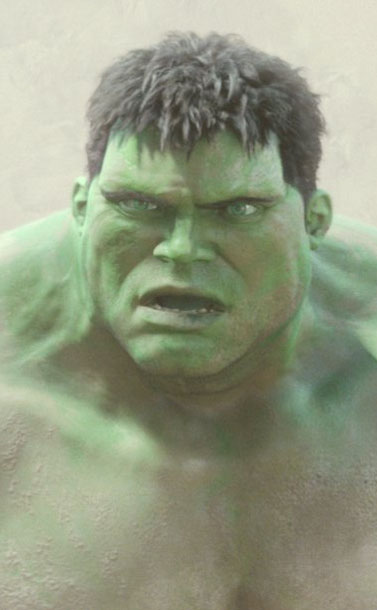
We’re nowhere near the bottom of this seemingly endless recursion when there’s one of those Laboratory Accidents so beloved of the old comic book writers: Bana takes an impossibly-high dose of gamma radiation; and, though he miraculously recovers, begins to display a propensity, when his hairtrigger temper is aroused, to turn into a gigantic green monster of immeasurable strength and run berserk about the countryside. [Well: you read the title on the ticket.]
This allows us to take vicarious pleasure in a great deal of recreational property damage and bear witness to the very satisfying exertion of the righteous wrath of Bana on a world full of assholes — starting with the dickhead romantic rival and working backward through assorted other threats to Connelly to the root of all evil, the great insensate and uncaring bureaucratic mechanism that is the Army — which, naturally, almost immediately tries to Take Charge of the Situation and sequester this new Secret Weapon in a picturesque underground laboratory in the desert [Area 51.5, I guess], where he can be studied and vivisected at leisure; later presumably to be cloned and deployed against Enemies of Freedom like the Commies, the Towelheads, and the Dixie Chicks. — Big mistake. — The Hulk promptly Busts Loose, and, after trashing an armored brigade or two for sport [too bad the Iraqis didn’t think of simply picking the tanks up and throwing them at the helicopters], bounds over a few intervening mountain ranges back to San Francisco; where, after a lot of even more intense conversations full of even huger closeups and illustrated by even more convoluted flashbacks, the analytical quest culminates in the denouement with Bana’s penetration into the inner mystery [almost the recovery of a repressed Lacanian primal scene] which lies at the root of his boundless and bottomless rage; for which the Hulk, as if you had to have it spelled out, is only a vividly realized metaphor.
Admirers of Ang Lee and his principal collaborator James Schamus will recognize a lot of this: the way, for instance, that Connelly abruptly retires to a cabin in an Enchanted Forest very like the one in which Chow Yun Fat and Zhang Ziyi fenced among the treetops, apparently for no other reason save to provide the Hulk with a picturesque backdrop against which to duke it out with Nolte’s dogs; the uncommon intelligence of the treatment of what would otherwise be rather tedious psychodrama [“It was like a dream,” says Bana of his possession by the Hulk — “About what?” asks Connelly, with wholly unexpected acuity — “Rage...power...and freedom,” he says]; and the explicitly mythological final shootout, which ends on a note of ambiguity almost identical to the denouement of
Crouching Tiger: Bana floating in water, as Zhang floated on air. — One must eagerly await their next project — which, if they continue to Think Green, will probably be something like the Muppets acting out Thomas Pynchon. [I can just hear Kermit proclaiming that “History is made at night.”]
What they certainly got right was the way that the Hulk moves; incredibly, Ang seems to have donned the motion-capture suit at ILM and acted out the part himself. [Is there anything this guy can’t do?] — They also deserve credit for the desert locations, the quotes from King Kong, and the return of product placement for Apple computers.
What they seem to have gotten wrong is the cartoonish appearance of the Hulk himself, which is intended, obviously, to put quotes around him. I’m not sure whether this was really necessary, but it wouldn’t surprise me to discover, eventually, that this too looks right.
Bana is great, but in his case upward mobility in Hollywood only means gaining the opportunity to allow Brad Pitt to drag his carcass around the walls of Troy. In the meantime check out the remarkable Australian film
Chopper [Andrew Dominik, 2000.] — Connelly needs to step away from these wife-of-the-great-man roles and take on something more demanding, say, the role of an major babe who inexplicably falls for a total loser. [Naturally I’m willing to offer my services.] — Cameos by Lou Ferrigno and the great Stan Lee himself; if there were any justice, these guys would be rich.
____________The bigger they are, the harder they fall (6/21/03)