There’s always a girl in the picture (1/4/01)
____________
Timecode. [Mike Figgis, 2000.]
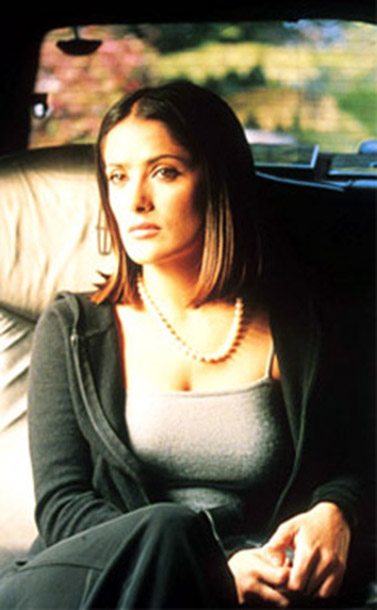
A dark comedy of Hollywood: rich and unusually possessive bitch Jeanne Tripplehorn gives her aspiring-actress girlfriend Salma Hayek a ride to an audition in a limousine; suspecting hanky-panky, she plants a bug in Salma’s handbag, allowing her to listen in as Hayek and Very Depressed producer Stellan Skarsgard [manifestly the kind of guy who has to buy his whiskey by the case] get it on behind the screen in a projection room where his staff are viewing the rushes of their current project [
Bitch From Louisiana; a Red Mullet Production], which is not, to say the least, going well. Salma’s generosity with her favors does not, alas, influence the boss to allow her to read for a part and she gnashes her teeth in despair for a moment in the ladies’ room, before emerging and stumbling fortuitously upon the director [the celebrated auteur of
Yo Grandpa], whose needle tracks are not so fresh as his judgment; recognizing star quality in his find, he reads her for the lead and proclaims her his choice for the role. Meanwhile Skarsgard’s wife Saffron Burrows, having psyched herself up with a visit to the shrink, announces to the producer her intention to leave him, despite his impassioned pleas that the two of them should renounce Tinseltown and retire to their villa in Tuscany. Taking a few more shots from the office bottle, he staggers into a meeting with his staff, led by Holly Hunter, who are all getting neck massages from Julian Sands while they debate their chances of getting
Bitch From Louisiana out the door and into a theater near you. Abruptly Ms. Tripplehorn enters and shoots Skarsgard: not quite the end.
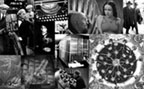
The remarkable thing about this film, of course, is that it was largely improvised, shot on digital video cameras, and presented as [unedited and continuous] simultaneous action in four windows on a quartered screen; the finished product, such as it is, is [roughly] the fifteenth take [the penultimate runthrough is also available on the DVD.] Figgis, a talented musician, provided his cast not with a screenplay but a sort of orchestral score in four parts, noting the points at which specific actions [in particular an earthquake] would have to be synchronized among the separate video streams: harmonically correlated, in other words, between distinct melodic lines; a sort of visual Dixieland. Much of his theoretical viewpoint is explained internally when purported eighteen-year-old girl-wonder European director Mia Maestro pitches the concept to the production company in a brilliant monologue which draws heavily on the theoretical writings of Eisenstein — and, in the kind of reference that is guaranteed to win my heart, compares the synthesis of the points-of-view of the individual cameras to the integration of the internal worldviews of Leibniz’s monads.
Figgis remarks in his director’s commentary that, after finishing this work, with the unique problems that it presented, it was difficult to contemplate going back to making ordinary motion pictures. Probably Nature is just trying to tell him that he’s too smart to make mere movies. — Should this message fail to get across, I’m sure his peers will find some way to remind him that an abhorrence of originality is the industry norm.
____________Le petit soldat (1/1/01)