The day the highlands stood still (1/14/05)
____________
Psych-Out. [Richard Rush, 1968. Written by Betty Ulius and Hunter Willet.]
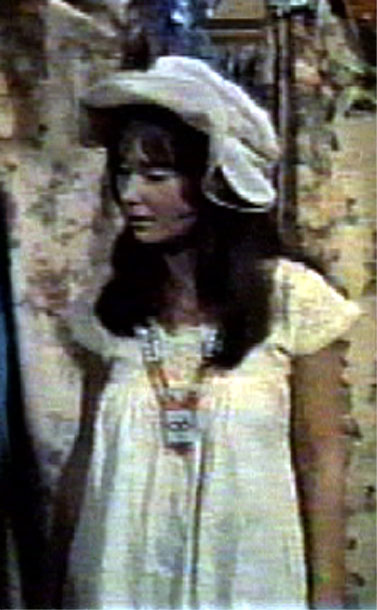
Bummed out and brought down by her plastic culture and her tawdry past, runaway gamine Susan Strasberg comes to the San Francisco of the Summer of Love in search of her errant brother Bruce Dern — a longhaired and bearded dropout who has, apparently, taken a few too many draughts of the Electric Kool Aid which was the vintage of that famous season, decided to be Jesus, preached the gospel of peace and love overrecklessly to various of the uptight and uncool in Golden Gate Park, and incurred thereby the enmity of a redneck lynchmob determined to make war not love; from whom, apparently, he is now in hiding. An easy conclusion to her quest thus frustrated, she falls in with psychedelic guitarist Jack Nicholson (shirtless and ponytailed with leather vest and what looks like an ankh hanging around his neck) and his merry band of hippie comrades, checks in at the quaint Victorian mansion which serves as their crashpad, submits to a fashion makeover at the Salvation Army which renders her a particularly fetching embodiment of the Zeitgeist, and enters into the adventures typical of the time and place — putting on The Man by pelting Him with flowers, playing lightshowlit concert gigs for crowds of cheerfully spastic zombies with eyes as big as saucers, staging impromptu pagan rituals in the park, imbibing wisdom at the feet of bogus gurus (this just in: we’re all still playing games), narrowly escaping a gangbang in the junkyard at the hands of red-state atavists in hardhats and letter jackets, stalking through a hallucinogenic Walpurgisnacht fueled by STP, and doing another of those famous psychedelic love scenes that in that distant age of cinematic innocence provoked many a stoned boner in the arthouses along the Sunset Strip. — Indeed, every motion is accompanied by tinkling bells, no ray of light falls upon the set without first being refracted through cut glass, lenses keep slipping out of focus even in the absence of obvious metaphorical intent, and everywhere you look there are people humping. Thus passed life in the heroic age.
This opus was produced by the redoubtable Dick Clark, creator of
American Bandstand, and its numerous eccentricities suggest the identification of a distinctive authorial voice: the musical interludes (by the Seeds and the Strawberry Alarm Clock) are execrable (Clark had a tin ear and was always strangely clueless as to what was hip and what was not); the dialogue is weirdly offkey (Dean Stockwell expires theatrically with the words “Reality is a deadly place...I hope this trip is a good one,” which dumbstruck viewers were still quoting with incredulous derision well into Reagan’s first term); there is a fair amount of sermonizing, as you might expect of a selfappointed Ambassador to (and from) America’s Youth; and some wouldbe Chekhov on retainer was allowed to decide that the scenario would have greater dramatic resonance if Ms. Strasberg were impaired in some picturesque fashion, say, if she were deaf. — After this the idea of letting her hook up with a musician must have seemed Fraught With Portent (as Bullwinkle used to say), and the insertion of a bit of heavyhanded exposition to reveal this to be less organic congenital affliction than the result of psychological trauma (meaning, naturally, that — by an application of the once ubiquitous Leary Fallacy — a major drug experience might reverse it) must have seemed natural. — Well: here was somebody’s brain on drugs.
On the other hand the (entirely accurate) impression you carry away is that though poverty is burdensome, drugs are potentially dangerous, free love is generally a convenient excuse for guys like Nicholson to nail anything with a pulse, and it probably isn’t a good sign when you wake up in the morning with little critters crawling all over you, the hippie experience on the whole was liberating and uniquely exhilarating. — So (as we said in the old days) it has a good beat and you can dance to it and (since the kids can relate to the words) you have to give it an eighty-five.
Moreover despite some inevitably hamhanded attempts at realizing the drug experience (to the best of my knowledge there was no real progress in the cinematic treatment of hallucination between Murnau’s
Der Letzte Mann and Terry Gilliam’s
Fear and Loathing, and this effort falls short even of Corman’s contemporary
The Trip — which Nicholson wrote, and which also featured the indispensably radiant Ms. Strasberg), this is one of those cases where the picture is, as it were, less important than the frame; it now exhibits a marvelous allure which transcends the (necessarily limited) aims of the authors and their time and place, because whoever really was in charge handed a camera to the great cinematographer Laszlo Kovacs and let him wander around the Haight capturing real hippies in their native milieu in the evanescent moment of their flowering — making it, in its singular texture and mise-en-scene, in its representation of posters, panhandlers, vans with psychedelic paintjobs, barefooted freaks dancing spastically to unheard music while onlookers nod and clap with arhythymic enthusiasm, a historical-preservationist document of great charm and power. — So he did his thing, and they did theirs, and the way they came together, well, it was beautiful. Man.
____________Antiquarian pursuits (11/19/04)