Surfin’ samurai (5/14/00)
____________
Nikki Fritz fans know her to be a girl abreast of the times, and will not be surprised to discover her riding the crest of the Prepare-for-Blair exploitation wave not only in the forthcoming
Bare Tits Project, but also in the Jim Wynorski opus
The Bare Wench Project. The famed exploitation auteur Andy Sidaris plans a cameo in this last, which will also feature the prodigious talents of Antonia Dorian, Julie K. Smith, and [natürlich] Julie Strain. — Point me at the woods, and, let’s get lost.
Meanwhile:
Space Truckers. [Stuart Gordon, 1997; written by Gordon and Ted Mann.]
Twentyfirst century big-rocket-rig wrangler Dennis Hopper battles a mad scientist and an army of warrior robots and saves the world but doesn’t get the girl; in this case no particular loss. — Why is Stephen Dorff now everywhere?
Reindeer Games. [John Frankenheimer, 2000; written by Ehren Kruger.]
Confused and distraught after his cellmate takes a fatal shiv [honestly, they called it a shiv] in a prison foodfight, Ben Affleck lurches out of the friendly confines of the state pen and into the scheming clutches of Gary Sinise and Charlize Theron, who may or may not understand that he is not their projected collaborator the late lamented but certainly seem insistent that he should help them knock over a casino on Christmas Eve. — Nice setup, promising caper, good sense of place [the Upper Peninsula of Michigan in winter — compare
Wonder Boys: will Hollywood yet discover America?], cute Magic-Christian ending, but, indifferent sex, unfocussed violence, and too many plot twists which entail the substitution of uninspired dialogue for action. — It is gratifying that Frankenheimer after so many years in the wilderness should finally have regained his rightful place on the directors’ A-list; it would be even better if someone would give him a script that didn’t suck.
Entropy. [Phil Joanou, 1999.]
A music video director [Stephen Dorff] acquires his first feature film assignment [a period piece about Lauren Holly’s tits] and his first model/trophy girlfriend [Judith Godrèche], then loses both to drink, indecision, venal producers, the tendency of isolated physical systems to tend toward states of maximal disorder, or maybe just the machinations of the minions of Satan, it’s never really made clear. — Apparently Joanou’s attempt at his very own
Annie Hall, but far, far short of the original. — With an extended cameo by U2.
Six Days, Seven Nights. [Ivan Reitman, 1998; written by Michael Browning.]
After just enough preliminary to establish without question that they are absolute opposites with prior romantic commitments, Cosmo-clone editor Anne Heche [not really Goldie, but trying as hard as she can] and hard-drinking bush pilot Harrison Ford [aiming about halfway between Gable and Cary Grant] crashland on a South-Sea isle and have a lot of predictably colorful adventures in which pirates shoot at them and tropical snakes crawl into their shorts before returning to civilization and dumping their once-significant others to set up the requisite memorable final embrace. I give them about ten minutes after the end of the third act.
Meet Joe Black. [Alan Smithee aka Martin Brest, 1998; written by Walter Ferris, after the play by Alberto Casella.]
Death takes a holiday and fucks the boss’s daughter.
A Civil Action. [Stephen Zaillian, 1998; from a book by Jonathan Harr.]
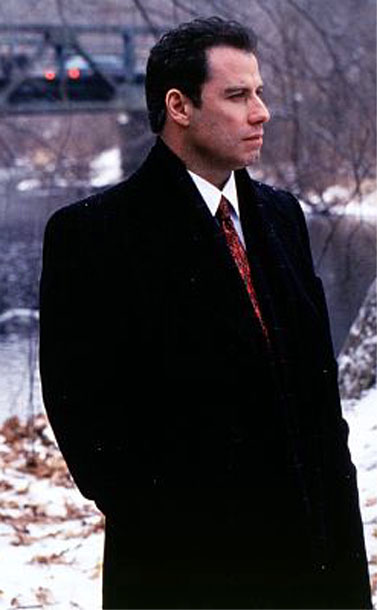
A true story: moneygrubbing personal-injury lawyer John Travolta develops a conscience [by spontaneous generation, or the descent of the Holy Spirit, or something] as he advances the case of the people of a New England town whose children were poisoned by industrially-contaminated groundwater; Satan’s attorneys, led by Robert Duvall [who is as always perfect] rip him a new asshole. — It is interesting that the conventions of this genre have become almost exactly those of Greek tragedy: Travolta, e.g., begins as a great and powerful attorney with an imposing office, a big house, and a new Porsche, and after gambling all of it and losing ends chagrined and abstracted in bankruptcy court, abandoned by his erstwhile friends and colleagues and if not precisely a broken man then at least chastened, meditative, genuinely puzzled by the fate the gods have decreed for him; an exalted sense of his own superiority, of course, is the flaw that has brought him down, but the explicit act of hubris [it is made absolutely clear] is that moment of overweening pride in which he declares that he can make the legal system serve justice. [A happy ending in such films always seems inauthentic and contrived; only deus ex machina, one will recall, saved Paul Newman in
The Verdict.] — The closing titles assure us that in real life the EPA worked a terrible vengeance on the monsters at Grace and Beatrice Foods, and that Travolta/Schlichtmann [having acquired the wisdom won through suffering of the aged wanderer Oedipus] is now a successful practitioner of environmental law. I take comfort in this promise of a happier sequel, and trust that, wherever Schlichtmann is, the gods now are with him; for the Bar Association most certainly is not.
Wonder Boys. [Curtis Hanson, 2000; written by Steven Kloves, after a novel by Michael Chabon.]
Very rumpled academic and once-successful novelist Michael Douglas, a guy who likes a drink, a drag on a joint, and the occasional appeal to pharmaceutical potluck, has taken to fainting in public; though actually, it develops, it is his girlfriend France McDormand who is pregnant [Douglas himself being involved in nothing more overtly biological than the gestation of an enormous and obviously unfinishable novel], and, though her status as chancellor of the university is not necessarily germane to the situation it is predictably embarrassing that her husband Richard Thomas is the head of the English department — whose willful ignorance regarding the involvement of the two lovebirds is not shared by his blind and perpetually furious dog, who seizes every opportunity to sink his teeth into the usurper’s leg. — Meanwhile Douglas’s own wife has finally left him, his editor/agent Robert Downey Junior is coming to town [he must be out on bail] to find out what happened to that new novel everyone has been expecting for seven years, the cute little cookie [Katie Holmes] from the afternoon seminar has abandoned subtlety and started wandering around the house in her underwear, the very talented kid [Tobey Maguire] who has decided to pass out on the couch may not yet write like Hemingway, but already drinks like Kerouac, takes drugs like Kesey, and exhibits the mental stability of Robert Pirsig, and somebody else seems to think he owns that ’66 Ford Galaxie Douglas is driving around Pittsburgh in the snow. In due course you discover what Marilyn was wearing when she married Dimaggio and what Errol Flynn liked to spray on his dick: this is not exactly DeLillo, but it doesn’t suck either. — James Ellroy does a cameo at the writer’s conference, and I sat all the way through the credits just to listen to Bobby Dylan. — Beautifully photographed by Dante [
Last of the Mohicans] Spinotti. Check it out.
Pitch Black. [David Twohy, 2000. Written by Jim Wheat and Ken Wheat.]
After crashlanding on a strange desert planet where all those Bedouin passengers are bound to come in handy, the protagonists [the Bad Good Guy, the Good Bad Guy, and the not-exactly Ugly Chick Pilot] discover in quick succession that [a] the last expedition to land here had their bones picked clean by the photophobic gargoyles in the caves beneath and [b] three suns or not, night is about to fall: just the right moment for a walk in the dark. — Once again [cf.
Supernova] there’s way too much handheld camera work in the action sequences [this is beginning to suggest an epidemic of that Oliver Stone cinematographic disease, the one that makes people try too hard to be hip]; and the characters [all apparently transplanted from somebody’s favorite Western] spend a remarkable amount of time standing around striking dramatic poses while delivering weighty speeches — to which I guess the monsters just out of shot in the shadows must also be listening with rapt attention, since inexplicably they don’t pounce. — Ridley Scott and James Cameron, I need hardly point out, would have known better. And so should you.
Man Ray Films. [Restoration supervised by Jean-Michel Bouhours, 1998.]
The famed photographer Man Ray [nee Emmanuel Radnitzky] attempted several celebrated essays in avantgarde filmmaking during the Twenties. Here restored and compiled are:
La Retour à la raison [1923];
Emak Bakia [1926];
L’Étoile de mer [1928]; and
Les Mystères du châteu du dé [1929]. The first precipitated a riot at its premiere; the last boasts among other fascinating sequences a passage in which a bathing beauty lies in a pool juggling rubber balls — by throwing them down into the water and catching them as they bob up, not tossing them into the air and catching them as they fall down. — Also included are several of Man Ray’s home movies, which include bullfighting footage Hemingway shot for him at Pamplona in 1929 and scenes of Picasso clowning around with Paul Éluard. — My principal announcement, however, is this: noting that the first two films feature the famous model Kiki of Montparnasse [the Boopsie of the French avant garde], I submitted her name and was at long last able to baffle the Oracle of Bacon at Virginia: Kiki and Kevin Bacon cannot be connected by a chain of intermediaries appearing jointly in feature films; Kiki, accordingly, has a Bacon number of infinity. [She does appear, however, in one of Man Ray’s portraits which hangs upon Emma Thompson’s studio wall in
Dead Again.]
Conceiving Ada. [Lynn Hershmann-Leeson, 1997.]
Francesca Faridany plays a gorgeous computer geek [yeah, right] whose forbidden experiments with computerdwelling artificial lifeforms aim to reconstruct the lost human past through some kind of datamining for which — typically — the lack of any coherent explanation is disguised by the deployment of a lot of fashionable MIT jargon. As her blonde-bimbo boyfriend points out, it is difficult to distinguish this project from an attempt to channel the spirits of the departed: in particular Francesca’s idol Tilda Swinton/Lady Lovelace, the mathematically-gifted daughter of Lord Byron; who, by virtue of her collaboration with Charles Babbage, is often regarded as the first computer programmer. — The boyfriend, obviously, knows nothing about machine intelligence but everything about motion picture scenarios; and, sure enough, Timothy Leary turns up immediately in the role of Francesca’s mentor, materializing on a television monitor intoning digital mysticism like “information is like a mist...you have to breathe it in...we are communicating in the vocabulary of light”, and Tilda’s principal “intelligent agent” adopts a dovelike avatar and flaps around in the graphical representations of her data searches like some kind of PlayStation version of the Holy Spirit. [I’m sure the scumbags at Doubleclick do it just the same way.] — Presently Francesca begins conversing directly with the sainted Ada, tracking the descent of this Woman Born Before Her Time toward her Tragic End...but wait a minute, Francesca’s pregnant.. you don’t suppose Ms. Hershmann-Leeson is about to invent digital metempsychosis?
Auch Zwerge Haben Klein Angefangen. [
Even Dwarves Started Small. Werner Herzog, 1970.]
Terry Gilliam once remarked that, thanks to his habit of meticulously storyboarding every shot in advance, and the fact that [as a former cartoonist] he always drew people with heads disproportionately large, he’d never really felt that his plans and his results had been visually consonant except when he cast the little guys in
Time Bandits; an experience which, accordingly, he invariably recalled with pleasure. — Even Terry, however, never cast a movie exclusively with dwarves; this was left to Werner Herzog, whose experiments with personnel have also included a couple of movies starring a schizophrenic, another in which he compelled the entire cast to perform in a hypnotic trance, and a long collaboration with the mad, bad, and dangerous-to-know Klaus Kinski, who never ceased threatening to kill him. — This early effort is, as you might expect, a variation on the tried-and-true inmates-take-over-the-asylum theme, and provides among its memorable images: an ancient van running endlessly in a circle; a chicken eating a mouse; two blind dwarves playing horsie on the back of a dead pig; a cigarbox full of insects dressed up in miniature wedding outfits; food fights; a demented little guy who never stops cackling; burning flowerpots; a horny dwarf who’s too short to climb up onto the bed to get at his girlfriend but keeps trying anyway [honestly, this is hilarious]; a cockfight; a procession led by a dwarf bearing a monkey nailed up on a cross; a guy trying to pick a fight with a tree; and the poster shot [cf. attached] a dwarf on a motorcycle. — Yeah, yeah, you’re saying; but when did this guy ever do anything really impressive, like shoot a movie about two cops in LA?
Double Jeopardy. [Bruce Beresford, 1999. Written by David Weisberg and Douglas Cook.]
Devoted wife and doting mother Ashley Judd pilots her sailboat out into the Pacific for an overnight cruise alone with her artdealer husband Bruce Greenwood; waking in the predawn hours from a drugged sleep, she follows a trail of gore out of the cabin right up to the deck and over the rail, and has just picked up a bloodsplattered knife in shock and disbelief when — conveniently — a Coast Guard cutter materializes out of the fog to bust her. At this point even astronomers viewing the movie through telescopes from other planets can figure out that it’s a setup, that Ashley is going down, and that when she busts out of the joint she’s going after the lying bastard and the conniving bitch he ran off with [Annabeth Gish] to shoot up his priceless Kandinskys and get her kid back and that Tommy Lee Jones is going to start out chasing her down and end up helping her get away. The rest is mere detail, and most of it — e.g., how the husband got the insurance money she was supposed to have killed him for, how Tommy the former law professor became an alcoholic parole officer, and why Ashley doesn’t actually bust out and at critical moments occasionally acts weak and womanly — is unimportant and unbelievable. - Very entertaining, but somebody should write this girl a real film noir. I fancy her in something like a remake of
Out Of The Past: when her back is up Ashley makes even Jane Greer look like Doris Day.
The Limey. [Steven Soderbergh, 1999. Written by Lem Dobbs.]
Cockney hardcase Terence Stamp steps out of a British slammer, gets onto a plane, flies to Los Angeles, and kicks the living shit out of everyone who stands between him and finding out why the wealthy and powerful record executive Peter Fonda killed his daughter:
Point Blank with a more sympathetic protagonist. — Very focussed; very elegant. — It is worth emphasizing that the composition of this picture — which relies systematically on jump cuts, temporal dislocation [indeed at times almost a kind of Burroughsian editing], the desynchronization of sound and action, and a kind of stylized cinema-verite cinematography employing not only the much-abused big handheld closeups but also the kind of unvarnished atmospheric longshots Vilmos Zsigmund devised for Altman in
The Long Goodbye — is brilliant; and demonstrates that in the hands of someone like Soderbergh who knows how to use it the postmodern film grammar can produce a sort of nonEuclidean action movie that is really wonderful to watch; far more satisfying than, e.g., Walter Hill butchering a space opera or Woody Allen pretending to be French. — With Luis Guzmán and the perennially dazzling Lesley Ann Warren as Stamp’s native guides, Melissa George as the little girl lost, and a younger Stamp, in black and white — excerpted from
Poor Cow [1967] — playing his own flashbacks.
The Great Texas Dynamite Chase. [Michael Pressman, 1977.]
Armed with a lit fuse and a sweet smile, Claudia Jennings busts out of the joint, and, assisted by partner in crime Jocelyn Jones, embarks upon an exhilarating career as a bankrobber whose powers of persuasion derive from her virtuosity with explosives. — The original redheaded bombshell in the original
Thelma and Louise: fast cars, beautiful women, moronic cops, loud explosions, and no bullshit martyrdom. Accept no substitutes.
Breakfast of Champions. [Alan Rudolph, 1999.]
An uneven homage to Vonnegut impressive mainly by virtue of a very talented cast, including Bruce Willis, Barbara Hershey, Buck Henry, Will Patton, Ken Campbell as the eccentric zillionaire Mister Rosewater, Nick Nolte crossdressing in pink lingerie, and Albert Finney [who could convince me he’s been sleeping in a dumpster] as Vonnegut’s fictional doppelgänger Kilgore Trout.
I’m Losing You. [Bruce Wagner, 1998.]
Television producer Frank Langella discovers on the eve of his sixtieth birthday that he is terminally ill; after the discharge of an appropriate number of subplots [in particular the one originally intended as the central metaphor of the piece, the one about the Dead-Souls trade in the life-insurance policies of AIDS victims], he is reconciled with his mortality and with his children Andrew McCarthy and Rosanna Arquette; and they with their pasts and one another, though not without the ancillary terminations of McCarthy’s lover, his exwife, his really cute little girl, and [in recovered backstory] Rosanna’s mother. — Dark though this summary may make the scenario sound, it is nothing, I assure you, in comparison with the original novel Wagner has here rewritten for the screen — in which a seemingly endless parade of repugnant characters drawn with appalling cynicism from film-industry life, obsessed, without exception, with fashion, celebrity, wealth, and the petty exercise of power, are introduced, marched back and forth for a few paces upon the author’s stage, and then clubbed to death by their creator in the guise of an alien implacable Fate. [The rather vain but not wholly unsympathetic elderly woman whose selfdeluding interior monologue Wagner provides on his very first page, for example, expires of colon cancer within a few paragraphs: to be precise, she crawls under her house to die in a puddle of her own shit. And after that it goes downhill.] If writing for the screen can temper his unrelenting nihilism, one must encourage Wagner to do more of it; it’s that, or drop the big one.
I Want You. [Michael Winterbottom, 1998; written by Eoin McNamee.]
Variations on a theme of Elvis Costello: Rachel Weisz stars as a hairdresser stalked by a former boyfriend who’s just emerged from the joint and an adolescent geek adroit with electronic surveillance gear who never speaks. The dramatic reversal is predictable, but it’s still amusing trying to guess when it will come.
The Whole Nine Yards. [Jonathan Lynn, 2000; written by Mitchell Kapner.]
Very nervous Montreal dentist Matthew Perry becomes rather more so when he is introduced to his new neighbor Bruce “Jimmy the Tulip” Willis, known, apparently, to every tabloid reader in the hemisphere as the hitman who killed seventeen people on contract and then ratted out his employers; and, sure enough, not a moment is wasted as Perry’s wife Rosanna Arquette [pretending to chainsmoke and affecting an unusually silly accent] simultaneously dispatches our hero to Chicago to sell the news to the Mob and tries to seduce Willis into whacking him when he gets back; meanwhile Perry makes the acquaintance of gigantic enforcer Michael Clarke Duncan, gangster kingpin Kevin Pollak, and irresistable gunmoll Natasha Henstridge, with whom [you saw this coming] he is immediately smitten. [Henstridge to Perry: “Go slow. I haven’t had sex in five years.” Perry: “Neither have I.” Off her look askance he explains: “I’ve been married.”] But it’s at the moment when Perry discovers that even his receptionist/assistant Amanda Peet has been paid to gun him down that you realize everyone in the movie is officially obligated to kill everyone else whether they want to or not; a predicament from which the protagonists can severally be extricated only by the exercise of considerable ingenuity on the part of the writers. — Hardly deep, but undoubtedly amusing, and certainly suggesting an advance upon the rather tired traditional wisdom that every tragedy must end with a death, every comedy with a marriage: for here you observe [by transposition under time-reversal] that one might say with equal justice that every comedy begins with a death, every tragedy with a marriage; and then advance to the conception of a kind of recombinant scenario in which it must develop that everyone gets laid or gets killed. — I look forward to this new trend in romantic comedy: just think how much more fun
Sleepless In Seattle would have been if Tom Hanks and Meg Ryan had been packing ninemillimeters.
Man On The Moon. [Milos Forman, 1999; written by Scott Alexander and Larry Karaszewski.]
Milos Forman recreates Jim Carrey/Andy Kaufman’s progress from misunderstood performance artist to misunderstood performance artist to misunderstood performance artist; establishing, I guess, some kind of hitherto unnoticed equation between Kaufman’s debut on
Saturday Night Live and the premiere of
The Magic Flute, and raising once again the profoundly disturbing question: do I actually want to fuck Courtney Love, or are the drugs still talking to me? — The drugs obviously are still talking to Christopher Lloyd, but one expected no less. — As for the perplexing final implication that Kaufman, having faked his own demise as a final put-on, may even now walk among us: surely he would have anticipated Jesse Ventura’s discovery of the royal road from the wrestling ring to the political arena; and, having done so, would now be a familiar face on CSPAN. But which one? Though I cannot be sure, I find that I am haunted by the vision of Al Gore — stiff, awkward, unnatural, robotic, a man seemingly born with no more rhythm than Don “No Soul” Simmons — or, well, Latka — stepping away from the microphone in the middle of his inaugural address, turning his back, and shedding that square whitebread suit to reveal the sequined jumpsuit beneath: and isn’t it about time we had a President who can do Elvis?
The Creature From The Black Lagoon. [Jack Arnold, 1954. Written by Harry Essex and Arthur A. Ross.]
Searching for the origins of a mysterious fossil which seems to represent a missing link between humanity and the lost denizens of the lizard world, paleontologist/adventurers Richard Carlson and Richard Denning venture to the unexplored headwaters of the Amazon; contending, the meanwhile, for the attentions of their megababe colleague Julia Adams. Becalmed in the murky waters of the mysterious Black Lagoon, they do what all brilliant movie scientists do in this situation, i.e., strap on their aqualungs and jump into the water to see if anything will try to eat them; thus making the acquaintance of the irascible Gill Man, an amphibious anachronism who is not at all extinct, has himself a pretty fair eye for a heaving bosom, and [as you might expect] begs to differ just who is hunting whom. — The famous submarine-stalker underwater sequences in this flick are still among the best ever filmed. — Arnold had a brief but brilliant career as a science-fiction auteur in the Fifties before settling down to pass his dotage directing the likes of the
Love Boat and
Gilligan’s Island; his credits include many of the classics of the drivein decade, including
It Came from Outer Space,
This Island Earth,
Revenge Of The Creature,
Tarantula,
The Incredible Shrinking Man, and the never-to-be-forgotten
High School Confidential.
Supreme Sanction. [John Terlesky, 1999.]
Balking at the order to whack investigative reporter David Dukes, la femme Kristy Swanson turns on her rogue-spook superiors Michael Madsen and Ron Perlman and, with the aid of ace hacker Tom [“Tiny”] Lister Jr., saves all the good guys and kills all the bad guys; and, wow, does she look good in ninja black. Hardly deep but certainly amusing; and an excellent career move for Terlesky, whom last I recall flexing before the camera opposite Monique Gabrielle in
Deathstalker Two.
Cookie’s Fortune. [Robert Altman, 1999; written by Anne Rapp.]
In a smalltown Mississippi even Beth Henley did not discover, dotty old lady Patricia “Cookie” Neal drops dead under peculiar circumstances; dotty younger ladies Glenn Close, Julianne Moore, and Liv Tyler contend for her estate. Charming and funny and animated by a great cast [Charles Dutton, Ned Beatty, Lyle Lovett, et al.] but not exactly a conceptual breakthrough.
Miscellaneous observations:
Best trailers of the month: Jet Li in the forthcoming
Romeo Must Die, directed by the famed cinematographer Andrzej Bartkowiak, an essay in action a la Hong Kong; Johnny Depp in the new Polanski supernatural thriller
The Ninth Gate [I guess he heard my wisecracks about
End of Days], also featuring Frank Langella, Lena Olin, and Emmanuelle Seigner.
An eminent paleontologist who has seen
Jurassic Park estimates that the average Tyrannosaur would need to eat 292 lawyers a year to maintain its body weight; this suggests, obviously, that the introduction of genetically-engineered predators might provide a natural mechanism for the control of the legal population. — Who says that the advance of science cannot provide solutions for our most pressing social problems?
In re the Oscars: in 1964
Doctor Strangelove was nominated for Best Picture; it lost, in an exemplary exercise of the professional judgment of the Academy, to
Mary Poppins. I think this says enough.
Later.
____________Flying fool (5/4/00)