Tempus fugit (2/8/00)
____________
Helen Mirren on her role in Guccione’s
Caligula [1980]: “It has an irresistable mixture of art and genitals in it.”
Compare the following:
Play It To The Bone. [Ron Shelton, 1999.]
When freak accident eliminates the scheduled warmup act at a title fight, washedup middleweights Antonio Banderas and Woody Harrelson get a call from a sleazeball promoter to fill the Tyson undercard on short notice; since neither has a car or can afford to fly, they persuade their mutual exgirlfriend Lolita Davidovich to drive them to Vegas, providing us once again with the familiar spectacle of two guys and a girl cruising through the desert in a muscle car [an Oldsmobile 442 Cutlass, and now I want one] with the top down. — But that’s what made this country great. — What makes Shelton great is his gift for character and dialogue; not here on best display, but, nonetheless, check it out.
Girl, Interrupted. [James Mangold, 1999; screenplay by Lisa Loomer and Anna Hamilton Phelan, from the memoir by Susanna Kaysen.]
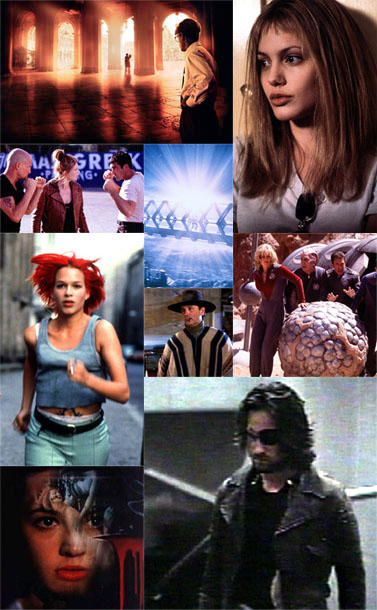
A tale so improbable that one must believe it is, indeed, true: Winona Ryder graduates from high school [no, really] in 1967 and gets tossed into a mental hospital because she feels sad and confused and makes a feeble attempt at suicide. Once in the joint, she and her fellow sad girls take some downers, watch some television, and bond in a restrained sort of way; meanwhile, as everyone remembers, thirty million functional schizophrenics were running loose in the streets taking over the country. Really, this is absurd. — Whoopi Goldberg and Vanessa Redgrave do their best in a bad cause trying to make the psychiatric profession look good [the shrinks’ vacuous definition of “borderline personality” brought down the house, and provided a perfect illustration of why psychiatry is barely a borderline science]; but the really memorable performance is that of Angelina Jolie, who despite the constraints of an inadequate script is little short of phenomenal in the role of the bull-moose loonie. — Rumor has it Ridley Scott is considering her for the Starling role, now that Jodie’s bailed from the
Hannibal project; I say give the girl a shot. Maybe she’ll vote for Eisenhower again.
Black Mask. [Daniel Lee, 1996.]
Jet Li, who gained prominence a couple of years ago as the only guy in
Lethal Weapon Four who didn’t suck, here appears in the role of a biologically-augmented martial-arts superman who dons a mask to combat his fellow Übercommandos — who, betrayed and abandoned by the police authorities, have decided to get even by taking over the Hong Kong drug trade. On those few occasions when Li’s own remarkable virtuosity is not sufficient in itself to suggest that he is more than human, the fight choreography of Yuen Wo Ping [now famous as martial arts director of
The Matrix] ensures the suspension of disbelief. Excellent.
The Red Violin. [Le Violon Rouge. Francois Girard, 1998.]
An interesting variation on the familiar theme of metempsychosis: the spirit of a dying woman passes into a violin [or sort of], whose adventures we then follow through halfadozen hands from Europe to Shanghai over three centuries until the auction that forms the frametale. Good cast, nice photography, no dramatic tension.
Run Lola Run. [Lola Rennt. Tom Tykwer, 1998.]
Redheaded technopunk Lola gets a call from her cute but apparently incompetent boyfriend Manni, who sold some smuggled diamonds for a very dangerous gangster and then lost the money and now has twenty minutes to find a hundred thousand marks before the payoff is due. Dropping the phone, Lola runs out the door and across the city to save him. And she never stops running. — Nor does this movie, which [employing a variety of media including film, video, montages of still photographs, and animation] loops three times through different variations of the story [and different relationships of action to consequence] before it nears a conclusion. In the process everyone gets killed at least once, and Herr Tykwer manages the weirdest quote from
Vertigo I think I’ve ever seen. — A brilliant essay on the themes of chance and necessity; an endlessly inventive exploration of the simple but profound truth that motion pictures ought to move; a German
Breathless. Check this out.
The Bone Collector. [Phillip Noyce, 1999. Written by Jeremy Iacone; after the book by Jeffery Deaver.]
Rookie investigator Angelina Jolie tracks a serial killer through the catacombs of Manhattan under the remote-control direction of quadraplegiac detective mastermind Denzel Washington. — Dressing up Sherlock Holmes as Stephen Hawking not only serves to promote
Seven Lite to
Seven-and-a-Half, but also provides that all-important excuse to keep Denzel’s hands off Angelina; for though Hollywood harbors no compunctions about showing us a guy eaten alive by rats, apparently it can’t show us a black guy making out with a white girl.
Supernova. [Walter Hill, under the pseudonym Thomas Lee (Alan Smithee’s career seems to be over); final cut (uncredited) by Francis Ford Coppola. Story by William Malone and Daniel Chuba; screenplay by David C. Wilson.]
It has now been several years since Siskel and Ebert devoted a feature segment of their program to the evolution of the Hollywood action cliche of people outrunning explosions; that summary already could conclude with the reductio ad absurdum of the clip from
Chain Reaction in which Keanu Reeves rockets away from a near-nuclear detonation on a motorcycle. Thus I spoil nothing — nay, it should be selfevident from the title — when I reveal that the grand finale of this opus is a scene in which a spacecraft outruns the shockwave of an exploding star. The surprise lies in just how dull the rest of the movie is: a medical vessel [apparently some kind of deep-space ambulance/hospital ship] responds to a distress signal from a remote orb [I guess nobody here saw
Alien] and finds a lone survivor of some mysterious disaster who seems to have derived malign superhuman powers from the weird alien artifact [a sample of “nine-dimensional matter”] he dug out of the ice on a chunk of rock everyone keeps referring to as a “Rogue Moon” [I can’t remember the origin of this turn of phrase, but I think it was a title of Alfred Bester’s]; after hosing all the women and beating up all the guys he gets tossed into the stellar catastrophe, and James Spader and Angela Bassett [first guys on the title cards and, duh, last guys standing] escape to fight galactic evil another day. — This film is a marvel of production design: the exteriors and the spaceship models are wonderfully detailed, and the CGI background paintings, beautiful; but though the interiors are not inelegant, because of an excessive use of big handheld closeups [which blur annoyingly in the action sequences] most of the movie might as well have been shot on the back stage at the Elks’ Club. — Further quibbles: giant stars are red, not blue [though admittedly that would spoil the color scheme]; at last report the universe is at least ten- or eleven-dimensional; and I am still wondering what the Woody Allen android from
Sleeper was doing on this ship. — Whatever the failings of this opus, it might have been worse: while I was waiting for the main event to commence I had to suffer through the trailer for
Battlefield Earth. Apparently in space no one can hear you yawn.
Sorceress II: The Temptress. [Richard Styles, 1999.]
Sister witches Julie Strain, Jenna Bair, and Julie K. Smith hire a new marketing executive into the family cosmetics firm; he becomes embroiled in a quest for supremacy between their black magic and the white magic of Sandahl Bergman. — An episode of
Charmed, only with better boob jobs. — The student of the output of the Corman exploitation empire will note much familiar recycled footage, including a personal favorite, the car wreck that killed Monique Gabrielle in
976-EVIL 2 [
The Astral Factor]: now there is a scream queen.
The Talented Mr. Ripley. [Anthony Minghella, 1999; after a novel by Patricia Highsmith.]
Working-class chameleon Tom Ripley [aka Matt Damon] is mistaken by the father of a rich ne’er-do-well for one of his son’s Princeton classmates and dispatched to Italy to bring the wayward lad back to run the family shipping concern. Once there, he develops a taste for the good life, murders the dissipated scion and takes on his identity, and then has to murder everyone else who may unmask him: Zelig as hitman. — I sat all the way through this wondering why it reminded me of
Strangers On A Train; but then of course discovered that Patricia Highsmith wrote that too. — Which provokes the inevitable comparisons. — Let’s simply note that, first, Hitchcock was very careful about the visual symbology of his casting, and, Ivy League Wasps or no, he would never have crashlanded like this on the Planet of the Blondes: Damon, Jude Law, Cate Blanchett, and Gwyneth Paltrow put together make a musical number by Julie Brown; and even I can detect the dye jobs. [Ms. Paltrow is emphatically not Grace Kelly, incidentally; the original remains the definitive ice blonde.] Second, he would have cut back on the carnage, because, third, he would have managed to tell the story much more succinctly. Minghella handles the recurrent near-unmaskings of Ripley deftly, to be sure, but the crises are too many and too similar: I kept thinking I didn’t need to go back for more popcorn, because the latest murder simply had to be the last; I kept thinking that for an hour. — And though comparisons with Hitchcock are doubtless unfair, comparisons with other Hitchcock homages based on Highsmith novels certainly are not; one can’t help pointing out that this movie falls far short of the standard of Wim Wenders’ remarkable
The American Friend [1977] — in which Dennis Hopper, a much darker Ripley, much further advanced in his perpetual identity crisis, stalks unforgettably about the fringes of the Hamburg artworld in a cowboy hat, embroiling the hapless Bruno Ganz in a series of contract killings. — With cameos, incidentally, by Samuel Fuller and the legendary Nicholas Ray; check that out instead.
Tinseltown. [Tony Spiridakis, 1997; after the play by Spiridakis and Shem Bitterman.]
Down on their luck in darkest Hollywood, writers Tom Wood and Arye Gross break into a selfstorage lot on Christmas Eve, looking for a place to crash, and discover it populated by an entire colony of starving artists; mistaking chief resident and manager Ron Perlman for a notorious serial killer, they pitch the idea for a snuff docudrama to sleazemeister producer Joe Pantoliano [who himself seems to be sleeping in his Mercedes], only to find that they’ve mistaken an actor’s preparations for actualities, and the murders they thought they’d witnessed were only scenes played in the film project of aspiring director Kristy Swanson. Combining forces, the four put together a joint proposal that seems to be taking in the money guys; at least until the real killer finds out about it. Clever and funny.
Return To Savage Beach. [Andy Sidaris, 1998.]
Action/exploitation auteur Sidaris continues his ongoing deconstruction of the spy thriller, combining once again his trademark elements: dumber terrorist plots, more musclebound secret agents, lamer expository dialogue, more ridiculous gadgets, flashier locales, more unmotivated chases and explosions, sillier ninjas, phonier martial arts masters, and girls in unbelievable outfits with even more unbelievable tit jobs; captained by the redoubtable Julie Strain. — Is this a formula, or what? — Fuck the money; when they come up with a game show that lets you win a chance to be this guy’s director of photography, I’m going after it.
SLC Punk. [James Merendino, 1999.]
Matthew Lillard takes the first person in this fictional autobiography of the only punk in Salt Lake City [circa 1985]; Michael Goorjian plays his best friend, and Annabeth Gish the proprietor of a head shop. Of course you know all along that he’ll give in to his father’s wishes and go to Harvard Law; but if more lawyers started out like this, we wouldn’t have to kill them. — Great soundtrack.
Shandra The Jungle Girl. [Surrender Cinema. 1999.]
Something about a jungle girl who is captured and brought back to civilization, where she fucks people to death. — I’d have a better idea, but after a couple of minutes I hit fastforward and scanted all detail.
Any Given Sunday. [Oliver Stone, 1999. Written by Stone and John Logan; after novels by Rob Huizenga and Pat Toomay.]
The student of molecular biology who views this movie will inevitably be reminded of the structure of the genome; in which, it has been discovered, the portions of the text that code for proteins [the exons] are interrupted by apparently irrelevant and accidental interpolations [the introns], which seem to represent genetic instructions left over from earlier stages of evolution, and must be spliced out and discarded in the processes of transcription and translation. — Similarly here we have the best football game [or games] I’ve ever seen, interrupted at unpredictable intervals by plot segments incorporated at random from earlier football movies; which one must, accordingly, skip over in the process of making sense of the viewing experience. [The fastforward on the tape machine is not the right idea; you need a conditional branch, an actual discontinuous goto.] — Thus it was, I must say, fascinating to see the audience [myself included] shouting encouragement like a sportsbar mob at a receiver streaking down the sideline and rising from their seats in anticipation when he leapt for the ball — even though the outcome of the play was decided in the final draft of the screenplay a couple of years ago and could hardly be considered to be, in any ordinary sense, in doubt. — Unfortunately to see these passages of action you have to sit through the intervening segments in which you are introduced to the all-too-familiar characters and their even-more-familiar mutual conflicts: the embattled coach, striving against all odds to make the playoffs one more time; his trusty sidekick, the defensive coordinator; the veteran quarterback who is one hit away from a wheelchair; the veteran quarterback’s wife, who [slightly against type] does not want him to retire; the upstart backup quarterback who scratches plays in the dirt and listens to rap music [but not of course the coach]; the upstart’s loyal girlfriend, dumped when he becomes a starter and a star; the mercenary running back who used to be a star until the upstart stopped handing off to him; the old team doctor, who dispenses drugs like candy; the new team doctor, momentarily a voice of conscience until he too starts dispensing drugs like candy; the veteran linebacker who is one hit away from a wheelchair; the skyboxdwelling MBA megababe team owner intent on micromanagement; her dead father; her alcoholic mother; the mayor she’s trying to bludgeon into building a new stadium with the thinly-veiled threat of moving the team to LA; the Machiavellian football commissioner who’s one hit away from a wheelchair; the supermodel groupie who’s one hit away from a wheelchair; the braindamaged scriptwriter who’s one hit away from a wheelchair...[sorry, I was drifting off] — played, variously, by Al Pacino, Jamie Foxx, Cameron Diaz, James Woods, Dennis Quaid, Edward Burns, Ann-Margret, LL Cool J, Tom Sizemore, Lauren Holly, Matthew Modine, Charlton Heston, F. Scott Fitzgerald, G. Gordon Liddy, K. Farley Dingwipe, and, shucks, just about everybody who is anybody. — Pacino does, in fact, do a respectable imitation of Mike Shanahan after a bender, but the real jocks are the best part of the show: familiar faces include Frank Gifford, Lawrence Taylor, Johnny Unitas, and the great Jim Brown, who remains a pretty respectable actor [nearly up to the standard of Buster Crabbe], and [for whatever reason] the only guy who looks like he really belongs here.
Galaxy Quest. [Dean Parisot, 1999. Written by Robert Gordon and David Howard.]
A movie which simultaneously celebrates and satirizes the
Star Trek cult: the cast of a longcancelled television show about a motley crew of space soldiers who cruised the galaxy blasting evil with rayguns are abducted from a convention by helpseeking alien fans who have received all the old broadcasts but don’t understand the concept of fiction; after amusing misadventures, the gang defeat an enemy menace and bond not merely with one another but with their followers on Earth and on other worlds. —
The Three Amigos, only this time funny. — With many startling special effects, including a mysterious spacewarp that looks like a movie of the eversion of the sphere, sex with tentacles, a giant Michelin rockman, and the contents of Sigourney Weaver’s brassiere.
The Stendhal Syndrome. [La Sindrome di Stendhal; Dario Argento, 1996.]
Undercover cop Asia Argento is introduced hustling into an art gallery, where, it develops, she has received a tip that a serial rapist she has pursued from Rome to Florence may be taking in the great masters amid a mob of tourists. Scanning the crowd for suspicious characters, her attention is somehow seized by the paintings around her, which begin to expand, develop threedimensionality, and absorb her into their internal spaces. Swooning, she cuts her lip against a table. In a dream she is underwater. A fish with the face of a really gnarly-looking guy swims up to her. They kiss. She comes to with a bloodstain on her blouse. She staggers out of the gallery. A guy follows her with her purse: the villain, naturally. She paws through it uncomprehendingly, apparently amnesiac. Finding the key to her hotelroom, she returns and attempts to collect her faculties; a Rembrandt hanging on the wall [but of course,
The Night Watch] starts talking to her, triggering a flashback to a crime scene that explains the backstory. Unfortunately while she’s swimming around inside the space of the painting the rapist is entering the space of the hotelroom, and when she returns to the present she is at his mercy. With a profoundly disturbing motion of the tongue he produces a razorblade from his mouth and cuts her lower lip — because, he explains, he wants to taste her blood when he kisses her — and has his way with her. She passes out. She recovers consciousness in the back of a car, where he is raping another girl whom he shoots as Asia leaps out the door and flees down the street. — Thus ends Act One; and, you may rest assured, what follows is even stranger. Suffice it that though she tracks down her assailant and kills him, the action [with Hegelian logic] only engenders its opposite, and that the relevance of Stendhal to all this is presently explained via that wholly familiar expository device, the conference with a psychotherapist. — Ah, yes, and she changes her hair for every act. — Who but Argento would cast his own [incredibly beautiful] daughter as the victim of a serial rapist?
Groundhog Day. [Harold Ramis, 1993.]
In Kaufmann’s translation: “[Suppose] a demon were to sneak after you into your loneliest loneliness and say to you, ‘This life as you now live it and have lived it, you will have to live once more and innumerable times more; and there will be nothing new in it, but every pain and every joy and every thought and sigh and everything immeasurably small or great in your life must return to you — all in the same succession and sequence — even this spider and this moonlight between the trees, and even this moment and I myself. The eternal hourglass of existence is turned over again and again — and you with it, a grain of dust.’ Would you not throw yourself down and gnash your teeth and curse the demon who spoke thus? Or have you once experienced a tremendous moment when you would have answered him, ‘You are a god, and never have I heard anything more divine!’ If this thought were to gain possession of you, it would change you as you are, or perhaps crush you. The question in each and every thing, ‘Do you want this once more and innumerable times more?’ would weigh upon your actions as the greatest weight. Or how well disposed would you have to become to yourself and to life to
crave nothing more fervently than this ultimate eternal confirmation and seal?” [Nietzsche:
The Gay Science, §341]?]
Escape From Ramseyville. [Leonardo Garbonzo, 1999.]
Leatherclad sociopath Snake Plissken falls into the hands of the fascist stooges of the New World Order and seems destined for a mortifying end until agents of the CIA and Mattel-XXX arrive at the eleventh hour with news that deranged ecoterrorists have kidnapped the prototype of the new lifesized Rollergirl Barbie and spirited her away to the Colorado Rockies, where they plan to hold her hostage against the capitulation of the android industry to unacceptable environmental demands; only the terminally attitudinal dude with the eyepatch, it seems, can rescue her from being rendered biodgradable. Though Plissken mocks their concerns and sneers at their offers of clemency, before the first act is out we find him tossed from a Stealth bomber into the stratosphere and plummeting on a parasail into the forbidden Walled City of the Überbourgeois, whence the terrorist broadcasts appear to originate. Captured by shambling psychopaths who call themselve executive recruiters, Plissken is chained in the dungeons of an employment agency and beaten for his refusal to amplify certain portions of his resume, marched at gunpoint through a succession of demeaning jobs from which he is fired by a succession of imbecilic employers, hounded by the Internal Revenue Service for failure to provide adequate documentation of a nonexistent income, evicted from a series of ratinfested apartments by pricegouging landlords, prosecuted for nonpayment of utility bills, and finally arrested on suspicion of poverty, tried for lack of affluence, and sentenced to lobotomy and a subsequent career as a systems administrator before he turns the instruments of torture upon his captors, busts out of the stinking cellars that house the victims of class warfare, and [as a dramatic chorus of the unwashed and underemployed sing “Up Against The Wall, Motherfucker”] executes a sizeable fraction of the population with a startling variety of weapons which provoke an unusually colorful series of explosions. Climbing over the wall with a stogie clamped in his mouth, as he is silhouetted against a reddening sky a familiar profile confronts him. — “Baby,” he says, “it’s you.” — “I have one word for you, Snake,” says Rollergirl Barbie [for indeed it is she]: “Plastics.” — As they embrace against the backdrop of the burning city, he lights a nuclear grenade with the butt of his cigar and flips it behind him into the remains of the metropolis. As a brilliant fireball forms behind them, in longshot profile they are seen walking toward the camera: out of the artificial sunrise, into the dawn of a new world.
Later.
____________Die Jungfrau von Orleans (12/24/99)