Dishonor among thieves (2/11/01)
____________
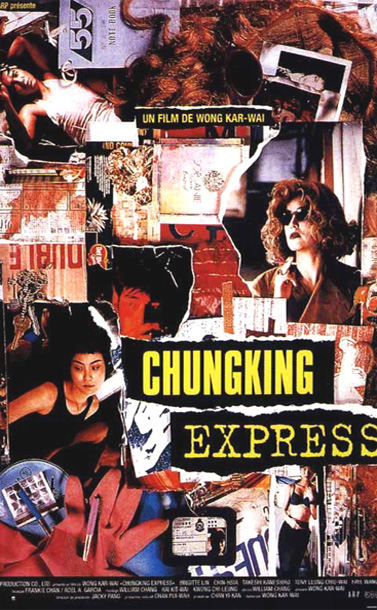
Chungking Express. [Wong Kar Wai, 1994.]
A couple of stories about a couple of lovelorn cops in Hong Kong, connected by the little fastfood stand [the Midnight Express] where they both occasionally hang out: since the first [Takeshi Kaneshiro] is dumped by his girlfriend May on the first day of April; every day for thirty days he buys another metaphor-laden can of pineapple with the expiration date of May first. When the new month arrives he abandons denial, eats all the cans at once, hurls like a volcano, and goes off to the bar for ritual cleansing, where he meets woman-of-mystery Brigitte Lin, in blonde wig and sunglasses, winding down after a rough day in the drug trade. The second [Tony Leung] is dumped by his stewardess girlfriend; the new waitress at the stand [Faye Wong] falls for him but [being a Wong character] finds it impossible to express her interest directly. Instead she begins to sneak into his apartment while he’s away, buying him groceries, doing his laundry and his dishes, and stocking his aquarium with fresh goldfish. The epitome of bachelor absentmindedness, he never seems to figure out what is going on; but finally catches her redhanded, absorbs the implications of her obsession, and asks her out. Abruptly she runs away to California to become a stewardess herself.
One of the cops advances the theory that jogging is good for the lovelorn, since sweat expels moisture from the body that would otherwise be shed as tears: something about this argument reminds me of Ben Jonson.
The VHS print [now several years old] is introduced by Quentin Tarantino [remember him?], who in an energetic albeit ungrammatical commentary explains that
Chungking Express was a near-improvisation tossed off as an aside while Wong was bogged down in the interminable editing of his epic
Ashes Of Time [1994]; it was originally intended as a three-story edifice, but when the first two parts seemed long enough, he left the third for a later film [
Fallen Angels.] Tarantino also points out the considerable debt of Wong to Godard; which, with a bit of a jumpcut, he chooses to illustrate with the admission that the Uma Thurman character in
Pulp Fiction was modeled after the Anna Karina character in
Vivre Sa Vie. [After all, that wig.] — The connection, actually, is best seen in the beautiful sequence [over which Tarantino enthuses at length] in which Faye Wong, solo, wholly unselfconscious though wholly selfpreoccupied, dances behind the counter of the fastfood stand while her boombox [tuned, apparently, to some Hong Kong source of American oldies] plays California Dreaming. This is an exact counterpart of the little dance Uma performs in her livingroom in
Pulp Fiction to an old Neil Diamond tune [Girl, You’ll Be A Woman Soon], and both are imitations of the poolhall ballet of Anna Karina in
Vivre Sa Vie.
It is curiously difficult to convey in words the appeal of these scenes, but Tarantino, certainly, has put his finger on one of the great mysteries of film: why something so seemingly simple as the spectacle of a girl, alone, dancing to a tune playing on a jukebox/a reel-to-reel tapedeck/the boombox over the refrigerator should be so endlessly fascinating.
[Compare Yeats:
That the topless towers be burnt
And men recall that face,
Move most gently if move you must
In this lonely place.
She thinks, part woman, three parts a child,
That nobody looks; her feet
Practise a tinker shuffle
Picked up on a street.
Like a long-legged fly upon the stream
Her mind moves upon silence.]
Wong may have been an obscure figure of the Hong Kong cinema then, but his new picture
In The Mood For Love [starring Maggie Cheung and Tony Leung] is opening to spectacular reviews in the U.S. At this rate he’ll be called upon for the next release of
Pulp Fiction to explain who Tarantino was.
____________Kiwi kino (1/27/01)