Falling bodies (8/8/00)
____________
From the IMDB Movie News, verbatim: ’Sony is making public descriptions of some of the scripts that it has had in recent development and has decided to abandon. The London Sunday Times listed some of them and the studio’s descriptions: “The Brothers (’a boxing champion is abducted by Nazis and replaced by his evil identical twin’); Voodoo Song (’A world-famous composer visiting a friend’s jungle plantation is attacked by a boa constrictor and nursed back to health by the chieftain’s daughter, who inspires him to write a jungle concerto’); Kiss Off (’An unwitting beauty consultant is lined up to kill a presidential candidate with a poisonous lipstick’), Circus (’An equestrian clown runs away to the city to become a stockbroker, but ultimately returns to save the family act’) and Cheap Thrills (’A man moves into a haunted house, where his ass is possessed by a demon called Captain Howdy’).” The Sunday Times added: “At least Cheap Thrills was intended to be a comedy.” ’
Reason given by an executive for cutting “Somewhere Over The Rainbow” from the first release of
The Wizard Of Oz: “No MGM star is going to sing a song in a barn.” — Posterity has not received the reason for restoring it.
Meanwhile, the hits keep coming:
Shanghai Noon. [Tom Dey, 2000.]
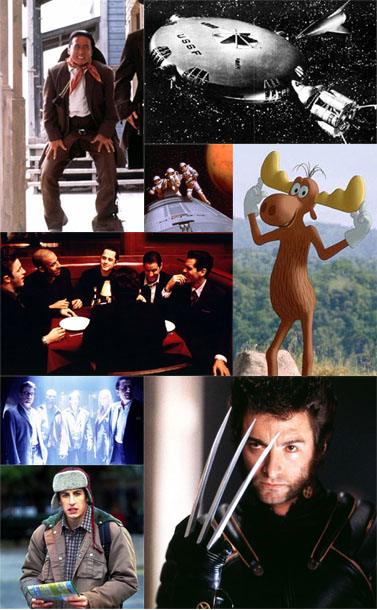
When agents of an exiled traitor spirit Imperial Princess Lucy Liu away from the Forbidden City to the wilds of Nevada in 1881, palace guard Jackie Chan takes up the pursuit, braving train robbery, Indian tribal initiation, dance lessons from triggerhappy cowboys, evil lawmen, railroad labor camps, whiskey, scarlet women, jailbreak, and near-hanging, and, finally, with the aid of Zen-airhead pseudodesperado Owen Wilson learns to ride and rope and shoot, defeats the bad guys, rescues the errant babe, and finds his place in the New World. Though it should be obvious that the suthors took pains to touch all the bases, the high point of the scenario, I think, was that palpable moment of anticipation when Jackie paused before entering his first saloon. “This is going to be good,” I said to myself. — I cannot tell you how good it was. Check this out.
Loser. [Amy Heckerling, 2000.]
Clueless weenie Jason Biggs comes to New York to experience social rejection at a famous university and falls for semiGoth-demigoddess Mena Suvari, whose prior commitment to despicably selfabsorbed faculty chickenhawk Greg Kinnear ensures satisfaction of the requirements of the dork-meets-girl, dork-loses-girl, dork-gets-girl structure that was either [a] dictated by the gods to Aristotle for inclusion in his
Poetics [b] handed down to the Israelites on tablets of stone or [c] engraved directly upon the genetic code. — The movie that’s destined to make you an Everclear fan. I guess. And teach you valuable lessons about daterape druggies. — With a cameo by Steven Wright that leaves me straining for the appropriate simile: James Joyce doing celebrity profiles for the
Rolling Stone?
The Adventures Of Rocky And Bullwinkle. [Des McAnuff, 2000.]
Moose, Squirrel, Narrator, Boris, Natasha, and a boatload of dumb jokes come back from retirement to contest the implementation of a nefarious scheme of Fearless Leader Robert De Niro to turn the American public into zombies by making them watch Really Bad Television and then convincing them to vote him into the Oval Office; a plan which, actually, first succeeded with Richard Nixon, but never mind that now. Thanks to an authentic Studio Green Light, excellent CGI, very clever casting [Jason Alexander is bearable, Piper Perabo does a fair imitation of Rosanna Arquette, Russo and De Niro are great, and somebody should actually offer the FBI director’s job to Randy Quaid], the fortuitous intervention of a travelling mattress salesman, and a stirring rendition of the Pottsylvanian National Anthem, Rocky and Bullwinkle can count their return a success. Now if we can only bring Jay Ward back from the dead.
Spies. [Spione. Fritz Lang, 1929.]
A mysterious gang of spies is running wild all over Berlin! and only Secret Agent #326, Donald Tremaine, can put a stop to their activities. No sooner has he slipped into town in disguise, however, than the agents of the sinister villain Haghi [a fiend confined to a wheelchair! by day a bank president! by night an evil mastermind bent on world domination!] discover his purpose, and a dazzling femme fatale is assigned to seduce and destroy him. Fortunately for the cause of European order, our hero is pretty cute after he shaves and changes out of his hobo costume, and the babe falls for him like a ton of bricks; amid the labyrinthine alleys of the dark city, despite the machinations of a host of shifty-eyed fops with fancy mustachios who smoke cigarettes in holders, love blossoms, Haghi’s schemes are frustrated, and the collapse of civilization is averted for at least a couple of months. — Maybe the first time anybody in a movie ever sported a miniature camera in his lapel; what did Lang not invent?
X-Men. [Bryan Singer, 2000.]
The first installment in what promises to be a series chronicling the adventures of the original teenage mutant ninjas, remarkable for the quality of its effects and the bodaciousness of its babes; organized around the voyage of self-discovery of the Wolverine [Hugh Jackman], who is not only possessed of superhuman strength and regenerative power, but also seems to have been biologically modified or engineered by parties unknown, with the result that, when he’s extremely pissed off, he extrudes Freddy-Krueger fingernails — and, maybe, snorts steam and spits acid; I might have paid more attention, but it was roughly at this point that Rebecca Romijn-Stamos showed up in blue body paint, and I was laughing too hard to absorb the nuances of this portion of the exposition. Also on display are Halle Berry, dispensing the thunderbolts of Zeus [and who better to dispense them]; Famke Janssen, who exhibits a strange power to cloud men’s minds [not exactly breaking news]; James Marsden as the lasereyed Cyclops; Patrick Stewart as the [but of course] wheelchairbound mastermind Professor X, and Ian McKellen as his rival for Principal Mutant Spokesperson, Magneto. The final shootout [at the Statue of Liberty] seems rather weak, but this was as I recall a chronic problem with the X-Men, since the necessity of simultaneously satisfying the disparate requirements of the half-dozen separate talents who would show up for the final conflict tended always to diffuse the resolution. — But: no one of consequence gets killed, and most of the major questions are left unanswered. I’m hooked. On to Mount Rushmore.
Divine Trash. [Steve Yeager, 1998.]
A then-and-now documentary about John Waters — a guy who liked to play automobile accident as a child, had a lucrative career as a puppeteer before he was a teenager, and then moved on into underground filmmaking with a series of sleazy low-budget high-concept features [
Hag In A Black Leather Jacket,
Roman Candles,
Eat Your Makeup,
Mondo Trasho,
The Diane Linkletter Story,
Multiple Maniacs] which culminated in what still must be regarded as the perfect date movie,
Pink Flamingos [1972] — starring the fabulous three-hundred pound transvestite Divine [“the Godzilla of drag queens”] — an exhibition of chicken fucking, cannibalism, tabloid journalism, white slavery, artificial insemination with a turkey baster, hermaphroditism, incest, castration, coprophagy, and a guy with a musical sphincter; the most disgusting movie ever made, and possibly the most original. No one was ever more brilliant in his solution to the problem of inventing himself as a director and an artist; indeed it is now difficult to remember whether, before Waters, there was an independent cinema.
Besides some priceless you-are-there documentary footage of the filming of his masterpiece [e.g., Waters coaching Divine on the right way to eat a poodle turd], there are interviews with numerous survivors of the era of underground and exploitation film and assorted representatives of the current indie cinema, including the Kuchar brothers, Paul Morrisey, Ken Jacobs, Herschell Gordon Lewis, David O. Russell, Hal Hartley, Steve Buscemi, and Jim Jarmusch; and with a variety of other witnesses to Waters’ rise to fame, among them the former film board censor for the state of Maryland, the [apparently deranged] Episcopalean priest who let Waters use his church for screenings, a couple of Extremely Serious psychoanalysts, and the univerally renowned but still anonymous Singing Asshole.
Project Moonbase. [Richard Talmadge, 1953.]
An ancient and curious Fifties television pilot which, apparently, represents the final chapter of the misadventures of Robert Heinlein in Hollywood: two rival astronauts to their annoyance are assigned to share the first exploratory flight around the Moon; when the machinations of a traitorous Red force a crashlanding on the lunar surface and a long wait for a rescue flight, the fact that one of them is male and the other female proves briefly an embarrassment to the bourgeois sensibilities of the home office. Fortunately the President of the United States [also, mirabile dictu, a woman, albeit one who sounds a whole lot like the Good Witch of the North] is able to marry them over the videotelephone before they can do anything they might regret. — A hopeless turkey, obviously, but one with occasional redeeming features: the zero-g conference in the space station where everyone is standing on a different wall is vintage Heinlein, the lunar background paintings are authentic Chesley Bonestells, and the tinkertoy lunar lander in which our heroes drift down to the surface bears an uncanny resemblance to the tinkertoy lunar lander Armstrong and Aldrin really did float down in fifteen years later. [Maybe this was just Von Braun’s design all along, I don’t know.] — And, incidentally, the obligatory heaving-bosom-on-the-acceleration-couch shot proves that those Fifties brassieres were good up to six Gs.
Boiler Room. [Ben Younger, 2000.]
College dropout but very professional hustler Giovanni Ribisi is recruited by a couple of slumming highrollers from the gambling casino he runs from his living room in Queens into a highwire brokerage firm that operates off-off-Wall-Street at the ends of Long Island; after mastering the intricacies of stocktrading and learning to exert hypnotic influence over the telephone lines, he discovers, naturally, that his obscene profit margins are not legitimate, and that the records are shredded every night, the office is prepared to move at a moment’s notice, and [this is the tricky part] the same names appear on every IPO. Even more ominous, all of his mentor-figures have memorized Michael Douglas’s dialogue from
Wall Street — which, however, is nowhere near as good as Ben Younger’s: obviously this is another one of those cases [compare Michael Tolkin’s vivid portrait of telemarketing in
The New Age] in which the author learned the manners and customs of his subjects by toiling among them. — But despite the Ferraris, the coke, the hotel-room gangbangs, the biker-bar punchouts with the wussies from J. P. Morgan, and the continual references to hiphop culture [“The Notorious B.I.G. said it best,” says Ribisi: “’Either you’re slinging crack rock, or you got a wicked jump shot.’ ...So I went the whiteboy way of slinging crack rock...I became a stockbroker...”], somehow I’m no longer satisfied by Imitation Gangsta. — I want the
New Jack City of stockbroker movies; I want to see these guys really killing one another.
Onegin. [Martha Fiennes, 1998; after Pushkin’s
Eugene Onegin.]
Jaded Russian nobleman Ralph Fiennes [cutting an appropriately Byronic figure in cape and top hat] wearies of the social whirl of Petersburg and goes into the country to settle the estate of his deceased uncle. Discovering Liv Tyler living next door, he loans her a volume of Rousseau to broaden her horizons and is somewhat disconcerted when, in consequence, she conceives a mad unbridled passion for him which [having, apparently, frozen his libido in liquid helium] he cannot reciprocate. One thing leads to another, and before you know it he’s matching pistols at dawn with somebody he doesn’t really intend to kill, but snuffs anyway [ironically, this was Pushkin’s own fate], necessitating remorse, exile, and one of those fabulously Romantic moments of mutual recognition when the two principals meet again in Petersburg after a separation of many years.
The question you are inevitably asking yourself here is whether this really was the most useless aristocracy in the history of the world; could they actually have been so bad that the Bolsheviks looked good? but it is not a question that receives an answer, since, in truth, all these costume melodramas have begun to look alike, and Pushkin’s drones seem no more sterile and unproductive than Edith Wharton’s New York plutocracy in
The Age Of Innocence; neither class, on the evidence of the motion pictures we have suffered through about them, having any better occupations than exchanging elevated sentiments in stilted diction at relentlessly overmannered dinner parties, aiming their glasses at one another during evenings at the opera, and casting brooding gazes out their windows at mysteriously pastoral urban landscapes.
Moreover, though all this makes excellent spectacle, for all the Petersburg living-museum exteriors, atmospheric forests, weathered peasant visages, ruined country manses, quaint native superstitions, acute discussions of The Serf Question, and deft portrayals of Coming Out In Society, it remains the case that Woody Allen closed the Russian-novel genre more or less permanently with
Love And Death, and there is, alas, no turning back.
House On Haunted Hill. [William Malone, 1999.]
A remake of the William Castle classic: eccentric millionaire Geoffrey Rush invites a party of strangers to spend the night in what he claims to be a haunted house, offering a prize of a million dollars to anyone who survives until the morning. At first this seems like an elaborate scheme designed to divert attention from his efforts to kill his wife Famke Janssen; then it seems like the whole affair is a ruse to disguise her culpability when she whacks him; then it becomes apparent that the house really is haunted by special-effects technicians who are intent on voting everyone else off the island. It all worked better with Vincent Price.
Mission To Mars. [Brian De Palma, 2000.]
When the crew of the first expedition to Mars goes offline under mysterious circumstances, World’s Greatest Rocket Jockey Gary Sinise [still totally bummed by the dramatically convenient demise of his wife] is pressed into service by his buddy Tim Robbins to join the dash to the rescue — which, predictably, gets to the Red Planet just in time to run into a meteor shower that wrecks the ship, necessitating a vertiginous spacewalk only slightly inconsistent with the principles of Newtonian dynamics and a Noble Sacrifice For The Benefit Of All Mankind on the part of Robbins completely consistent with the principles of screenwriting — eliminating as it does the mentor figure from the plot at the industry-standard two-thirds mark on the dipstick of the scenario, and setting up a seat-of-the-pants crashlanding from which our remaining heroes walk away with no more than a couple of motherboards and a change of underwear to make the flight back. Tracking down the lone survivor of the first-act disaster [a guy who is by now, in somebody’s telling phrase, a few mealpackets short of a picnic], they hear a harrowing tale of disaster and discovery on the Red Planet, and in short order fathom the secret of the Face On Mars [to my disappointment, seen up close it looks nothing at all like Ted Kennedy or Madonna] and get a tour of the Stanley Kubrick theme park the alien masters of the cosmos have thoughtfully left behind them to explain the origin of species. In a grand finale Sinise launches himself “to infinity! and beyond!” on a mammoth Martian Roman candle and I launched myself back into the parking lot — where, as I whistled an old familiar tune, I entertained the following questions:
Why is it only Kubrick ever had enough sense to leave off his explanations before they started to sound stupid? Was Keats right about negative capability? Is it that rare? Is it that difficult?
But the zero-g stuff was great; how did they do it?
Was that a CU Buffalo on the space station bulletin board behind Armin Mueller-Stahl?
Isn’t it interesting that, thanks to the speed-of-light delay, when the shots are properly intercut, you can interpret as simultaneous the reaction of the guys on the spacestation to the message the guys on Mars are sending, the act of sending that message, and, also, what the guys are doing on Mars twenty minutes later? [Who but De Palma would have figured this out?]
Since this is essentially the same meteor strike that waylaid the Mars expedition in
The Conquest of Space [George Pal, 1955], isn’t it about time to retire this particular plot device?
If there’s a face on Mars, what’s on Uranus? [I know, I know; but how can you resist?]
If aliens did design the genetic code [not so dumb an idea, Francis Crick wrote a book about it], wouldn’t there be a copyright notice hidden in the genome somewhere?
What is Scott Steiner going to do about Kevin Nash powerbombing his girlfriend Midajah? Why can’t I get to do stuff like that?
Are there Martian twisters? would they look like these?
Doesn’t the ease with which you can contrive these accident-prone planetary-exploration plots make an excellent argument for foregoing dumb stunts like sending people to Mars four at a time and mounting a serious scientific expedition instead?
If happy little bluebirds fly/Beyond the rainbow/Why oh why/Can’t I?
But enough of this merry sport. I’ve got to talk to Captain Howdy.
Later.
____________Rocket scientists (8/4/00)